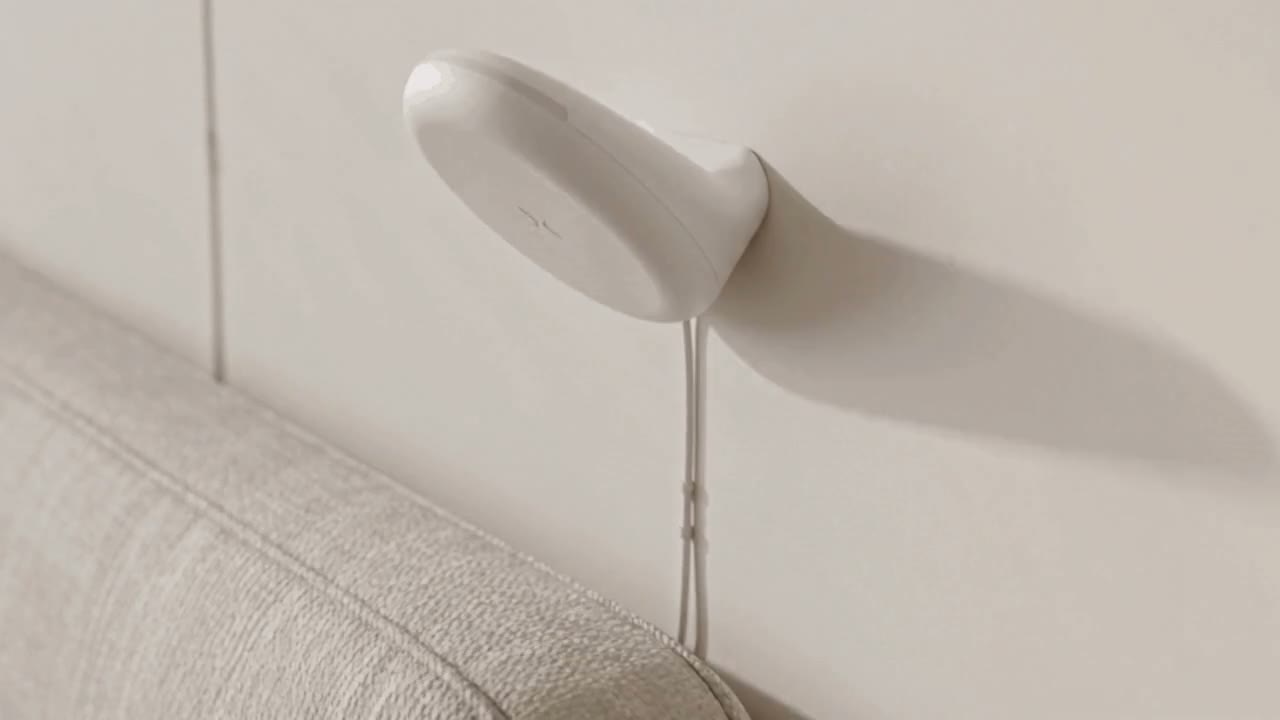
A small radar disc by the bed reads your resting heart rate and breathing through the duvet, every night. In care settings it has shown a change an average of 4 to 6 days before a diagnosis.

The clinical device, FDA-cleared since 2021. Continuous heart rate and breathing from your bedroom to the clinician who looks after you. If your doctor or care provider runs a remote-monitoring programme, they can prescribe it for you.

A general wellness product built on Xandar Kardian's radar technology, for your own bedroom. It is not the cleared device and its readings are not FDA-cleared. Your resting heart rate, breathing, movement and time in bed, compared with your own nights. Wi-Fi or Bluetooth. Not a medical device.
Works with the free XKare app on iPhone and Android.
How the sensor reads you: the chest rising with each breath, moving with each heartbeat.
One radar, two products. On the XK300 Essence, heart rate and breathing rate are FDA-cleared measurements, prescribed through a care provider. Kardian Somily is a separate general wellness product built on the same underlying radar technology: it is not the cleared device, and its readings are for your own information, not FDA-cleared. Neither product diagnoses, and neither is an alarm.
Six to ten thousand readings a night. Taken only when you are still, because that is when they mean something.
It learns your own resting heart rate and breathing, night after night. Then it compares each night with yours, not with a chart.
Illustrative. Sixty nights of one person. The shaded band is their own usual. The last ten nights sit outside it.
In the morning, last night sits beside your own recent nights, in plain words. No grades, no colours to decode. The same picture reaches a clinician with the Essence, and reaches you with Somily.
Grey dots are your own recent nights, on your own scale. Blue is last night. Illustrative.
“Compared with your last seven nights: breathing higher, heart rate similar, longer in bed.”
That is the whole message. Your resting breathing ran a little faster all night, and your body did more work while you slept. It is often why a night that looked long still felt short.
Your body fighting something off, a late meal, a stressful week, a drink too many. Most shifts settle in a day or two, and you can watch them settle.
It does not diagnose anything and it is not an alarm. If a shift keeps up for several days, consider checking in with a healthcare provider.
Two nights can average the same breaths per minute and feel nothing alike. The sensor keeps the spacing between breaths, not just the count.
Both nights average fifteen breaths a minute. Only the rhythm differs. Illustrative. The film below explains it.
How clean and regular each heartbeat looks to the radar, tracked against your own nights. In Somily, a wellness trend. In the XK300 Essence, investigational and part of an ongoing study.
Strength and rhythm, read from chest movement. Illustrative. A wellness measure, not a medical one. The film below explains it.
Heartbeat Clarity runs from 0 to 1. A healthy, regular heartbeat resolves cleanly, near the top of that range. In the care-setting record, readings of 0.1 or lower have shown a strong association with the heartbeat patterns seen in heart failure. That observation is part of ongoing discovery and research with cardiology hospitals. It is not a cleared measurement, it does not diagnose anything, and Somily does not act on it. It is why the reading is worth having.
A ring or a watch estimates your heart from the pulse in your finger or wrist. Kardian measures the heartbeat itself, as the movement of your chest with every beat. That is what makes Heartbeat Clarity possible: how cleanly and regularly each beat comes through, night after night, a reading no wearable can make. The breathing waveform comes with it, so it follows the rhythm between breaths, not just the count. Two and a half minutes on both.
In Somily, breathing rhythm is a wellness trend and Heartbeat Clarity is investigational. Neither is an FDA-cleared measurement. More on the science page.
Nothing to start, nothing to sync, nothing to remember. The morning summary is waiting on your phone.

A small light shines into your wrist or finger and an algorithm works backwards to a number. It has to guess through movement, skin tone and fit, and it needs charging.

Radar senses the chest rise with each breath and move with each heartbeat, through the duvet, from the wall. Nothing touches you. Readings are taken only while you are still.
Most contactless sleep sensors use millimetre-wave radar, at 60 or even 120 gigahertz. Those short waves bounce off a duvet, so they need you uncovered and face-up, and they average what they get.
Kardian uses a 7.3 gigahertz impulse radar, in the same range as your Wi-Fi. Long waves go through bedding and clothing, in any sleeping position, at more than a hundred times less power than a Wi-Fi router. It is the radar technology hospitals and care homes have used since 2021.
The XK300 is the radar Xandar Kardian has placed in hospitals, nursing homes and home care for years. The Essence is its prescription form, for your bedroom through your care provider. Somily is the wellness version you buy yourself.
Everything below is a look back at records from care settings where the clinical XK300 was in use. It is part of an ongoing discovery and research programme, and we show what we found. "Days before" is the interval between a shift in a person's own readings and the date the diagnosis was recorded, averaged across events and measured after the fact. None of this is a claim that any Kardian product detects, predicts or diagnoses a condition, and no such use is cleared. The heart failure work is a small study in progress. XK does not predict or diagnose health events.
108 confirmed events. Read the study
189 events in our retrospective analysis. The protocol and the outbreak case were published in Gerontology and Geriatric Medicine, 2024.
390 journeys, reviewed afterwards. Read the case study
A number from 0 to 1 for how cleanly and regularly each heartbeat resolves in the chest-wall movement the radar reads. Strong, even beats read near 1. Weak or uneven beats read low. It is not heart rate, and it is not an ECG.
What we have seen so far: in our February 2026 retrospective analysis of 28 documented heart failure events, the pattern matched in 73.2% of them, and Heartbeat Clarity had dropped to 0.1 or lower in every one. A small sample. It is part of an ongoing discovery and research study, and a global clinical trial is under way. We are showing what we found, not claiming that any product detects, predicts or diagnoses heart failure. Heartbeat Clarity is investigational and not a cleared measurement. How we are studying it.
Retrospective findings from the clinical XK300 in nursing homes, and published work: the average interval between a shift in readings and the recorded diagnosis, measured after the fact. Part of ongoing discovery and research. Not cleared indications, and not claims. XK does not predict or diagnose health events.
Kardian Somily is a wellness product. It is not a medical device, does not diagnose, and is not an alarm. The XK300 Essence is a prescription device supplied through remote-monitoring and care providers.
XK does not predict or diagnose health events. If you have a health concern, talk to a healthcare provider. The sensor is a source of information, not a decision.
Larry and Susan bought the sensor and have lived with it at home for months. Precious Myers Brown uses it in the facilities she runs. Dr. Serrano is a physician whose facilities use the clinical XK300. Courtney lived with the sensor for several weeks and was compensated for her time. Each speaks from their own experience; none was scripted.
Same placement for the Essence and for Somily. Two strips of tape, one cable to a USB plug. Then go to sleep.

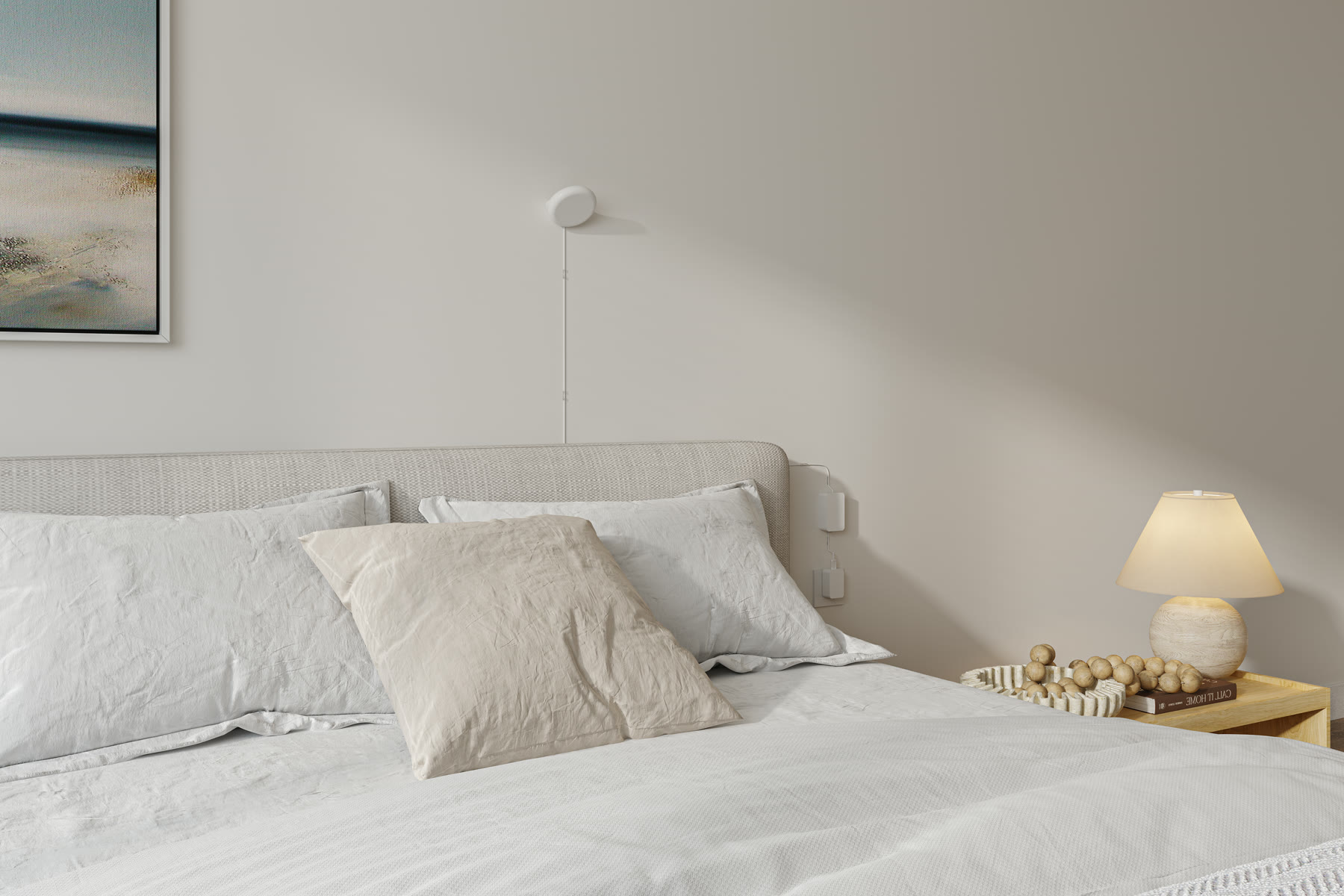
About 1.5 metres from the floor, on your side of the bed. If you share the bed, left or right above you. If you sleep alone, the centre.

It does not have to sit high. Closer to the body, just above the mattress, keeps the cable out of sight.

Out of sight between the wall and the headboard, as long as the bed does not need to sit flush to the wall and the headboard is not a solid metal plate.

It does not recognise faces or names. It collects from the closest body. Mounted above your side of the bed, left or right, it reads you.
If you both want readings, you each have your own sensor above your own side, as in this bedroom. Each one pairs to its own person in the app. If you sleep alone, it goes in the centre.
Hugging, or drifting onto the other side for a while, is fine. When the sensor picks up two sets of vital signs at once it pauses automatically. And with six to ten thousand readings a night, two hours on the wrong side barely moves your baseline; the numbers settle. Just do not swap sides for good without moving the sensor.
No band, no ring, no patch. Nothing to remember at bedtime.
No lens. No microphone. It reads movement, not pictures or sound.
USB power from the wall. It is never flat in the morning.
If a clinician or a remote-monitoring provider looks after you, they supply the XK300 Essence on prescription. For your own wellness at home, Kardian Somily.
No. Keep it. A ring is good at daytime activity, HRV, skin temperature and sleep stages; we do not do those. We measure breathing and resting heart rate from the chest, through bedding, with nothing worn, and compare each night with your own. Read both in the morning. The side-by-side.
It collects from the closest body. Mount it above your side of the bed, left or right, and it reads you. Two people, one sensor each, above each side, each paired to its own person in the app. Hugging or drifting over for a while is fine: if it picks up two sets of vital signs it pauses, and with thousands of readings a night, a couple of hours on the wrong side barely moves your baseline. See the two-sensor bedroom.
No. There is no lens and no microphone in the disc. Radar reads movement. It cannot see a face or hear a word.
Yes. The wavelength passes through a duvet, a topper and clothing, in any sleeping position.
Above the headboard at about 1.5 metres, near the bed corner just above the mattress, or behind the bed frame. Two strips of tape, one cable to a USB plug.
No. It runs on USB power from the wall, so it is always on and never flat.
Yes. The radar runs at more than a hundred times less power than the Wi-Fi router already in your home, and this radar technology has been used in hospitals and nursing homes since 2021.
Yes. Kardian Somily is HSA and FSA eligible in the United States. Keep your receipt; your plan administrator has the final say.
No. Somily is a wellness product for your own bedroom. The XK300 Essence is a separate, FDA-cleared prescription device, set up through a remote-monitoring or care provider.
Programmes, evidence and pricing for organisations live on our clinical site.